Underdog Best Ball Draft Strategy For Late First-Round Pick: Start James Cook And Ashton Jeanty?
Jonathan Fuller examined the different strategies for Underdog best ball drafts when picking from a late first-round slot.
Your draft just filled and you find yourself picking at the end of Round 1, now what? It may not be as ideal as picking at the top of the draft, but you can build a very strong squad from this position. As we'll see in this article, the 2026 ADP landscape funnels you to a particular type of build when picking at the end of the first round. In this article we will look at the common sense approach to drafting from a late slot as well as some contrarian ways to draft that still put you in position to build a great team.
As usual, I will be referencing Underdog ADP, scoring and tournament formats because that is where I draft most of my teams.

Join Our Newsletter
Trusted by 400,000+ fantasy football players. Get access to Fantasy Life's free award winning newsletter and tools, all in one step.
By registering or logging in, you agree to our Terms of Use and Privacy Policy.
Best Ball Draft Strategy for Late First-Round Picks
The Logical Start: Double-Anchor RB
Unless you get someone to fall to you a few picks after ADP, the most obvious way to start your draft is to double tap the RB position with two guys from this block of ballcarriers. That is certainly the direction that the current ADP landscape will push you because I didn't put any positional filters on this list, there are just eight consecutive RBs that go off the board at the end of the first round through the middle of the second round.
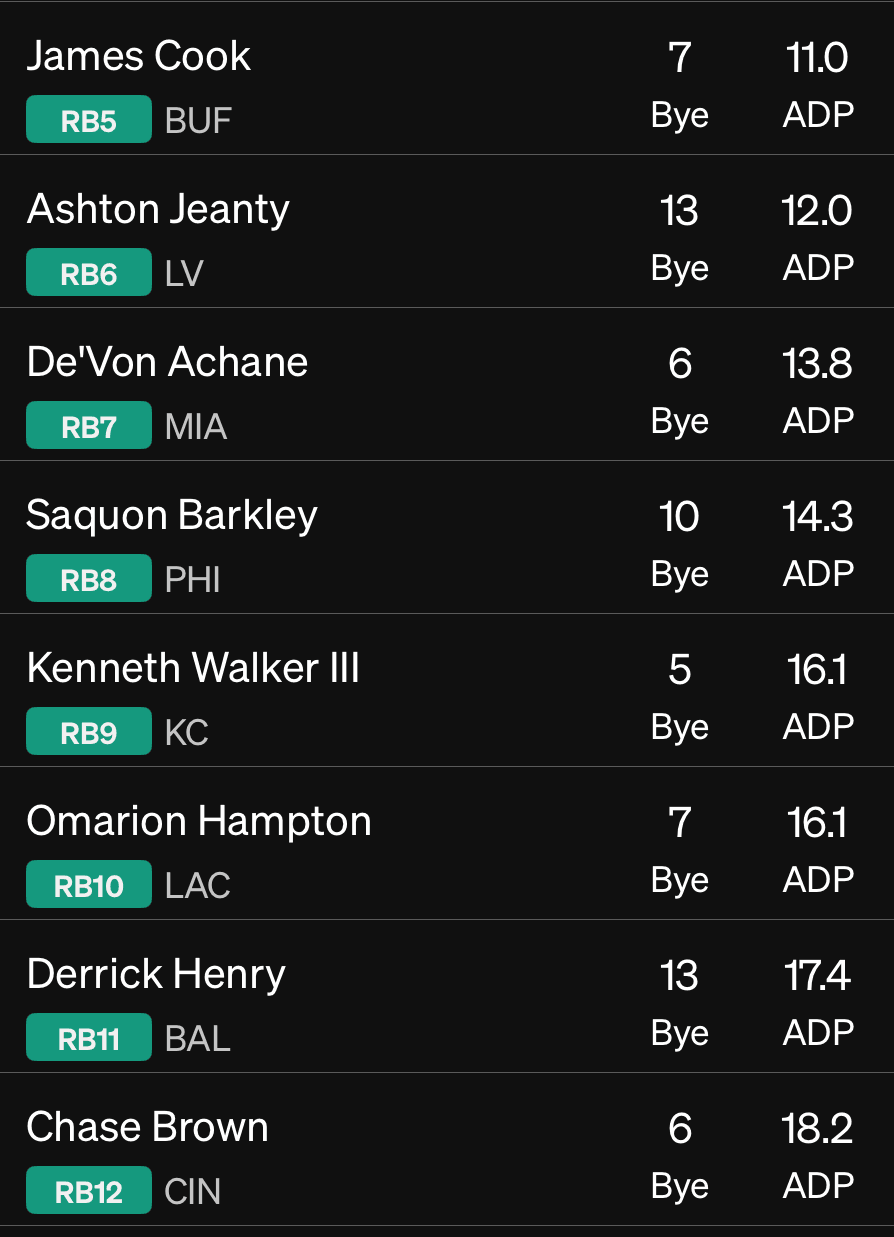
The positional choice may seem obvious, but picking the actual players is more subjective. There are a wide range of profiles available here so you'll have to decide who your favorites are. Personally, I like Ashton Jeanty, James Cook and Kenneth Walker as my top 3 options among this group.
Of course, over a large portfolio of drafts you should probably mix and match who you are taking in this range, but for now we are focused on building one hypothetical team. After securing two bell cow backs, you'll have a long wait to the end of the third round and beginning of the fourth round.
Navigating the Middle Rounds
When you start with two RBs, you generally want to find a way to get back to a somewhat-balanced build through the middle rounds. Fortunately, the draft board sets up in a way that it isn't too difficult to accomplish. At the end of the third round and beginning of the fourth round there is a nice pocket of WRs who still have the upside to be week-winning players in the best ball playoffs.
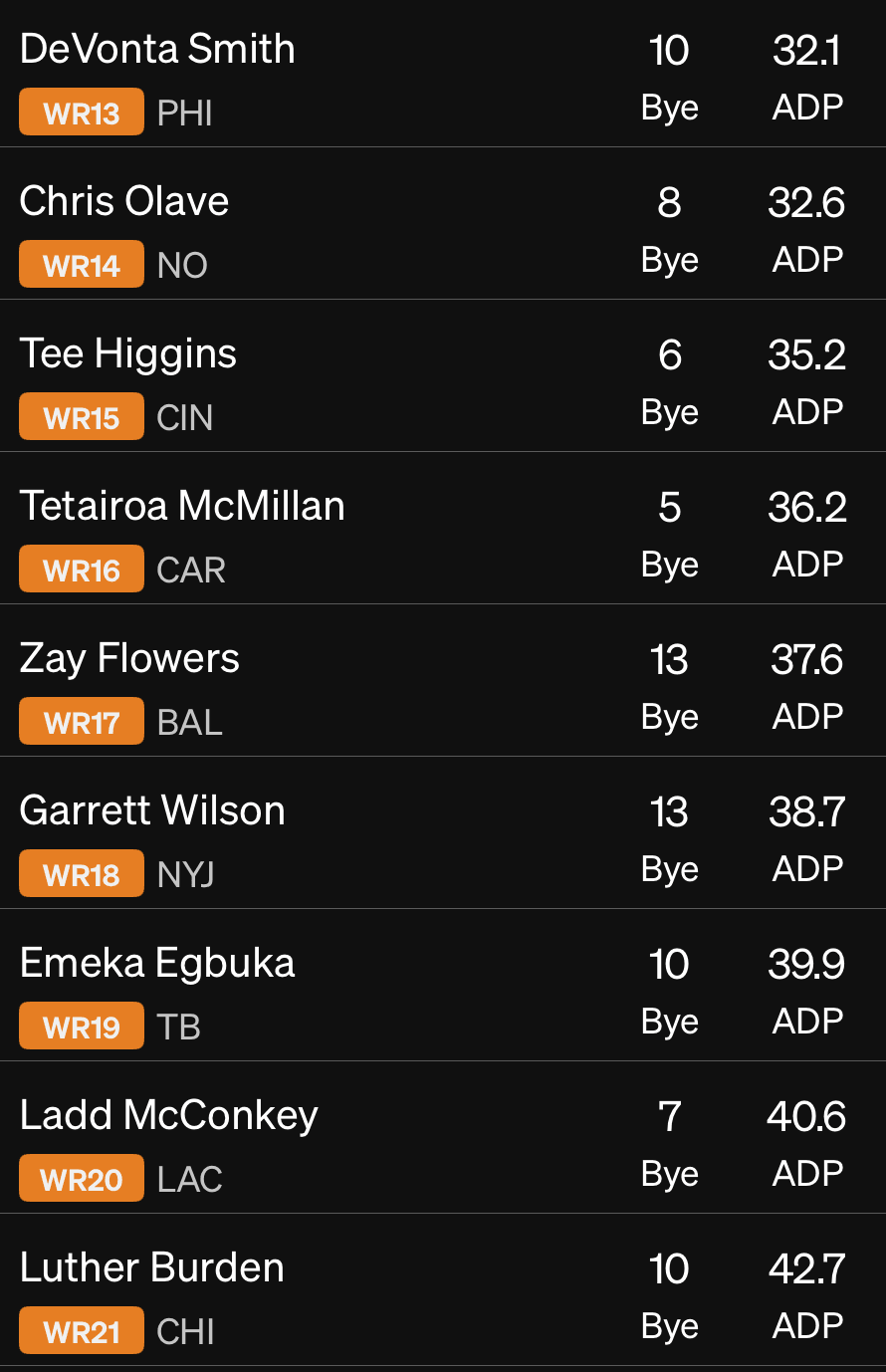
As a rule of thumb I would say you pretty much have to take at least one WR here, and in many cases you should double tap the position unless there is a great value available elsewhere. Of the WRs in this range, I find myself taking a lot of DeVonta Smith because I expect him to rise when A.J. Brown is inevitably traded. Assuming he won't be available in this range forever, my other favorites are Tee Higgins, Tetairoa McMillan, Zay Flowers and Luther Burden.
If you do have two RBs and two WRs through four rounds, you are set up nicely to take value in rounds 5-10 without falling too far behind at any position. With this start you are likely trending toward a 3-5-7-3, 2-5-8-3, or 2-6-7-3 roster construction depending on how you prioritize RB vs. WR with your next few picks. Just make sure to get two QBs before the position dries up in the early double-digit rounds and you will likely feel good about your roster at the end of the draft.
Contrarian Draft Options
The path discussed so far makes a lot of sense and is a good way to build a competitive team with a late-round draft slot. However, if you are drafting a lot of teams you should also consider mixing up your strategy from certain draft slots so you aren't just building the same team over and over again. In practice, I like to make about 10% of my builds a 'contrarian' roster where I intentionally do something different in order to force myself to build a different type of team. When picking at the end of Round 1, there are two contrarian builds that stand out to me as good options:
- Pull up a Round 2 WR or TE
- Go hyperfragile RB
For option No. 1, you are essentially betting that someone like Malik Nabers, Rashee Rice, Drake London or Brock Bowers can return the value of a top-12 pick and we are choosing to pair them with a player whom they won't often be rostered with. For example, a Cook-London or Jeanty-Nabers start doesn't happen very often, but it isn't too difficult to imagine a scenario where one of those combinations help take down a best ball tournament.
This start does give you a bit more flexibility later if there is a great value or if Josh Allen falls to you at the end of the third round and you want to grab an elite QB.
With option No. 2 you are still starting with two anchor RBs, but then we are taking two more in the middle rounds so that we have at least four RBs through the first six rounds. As I wrote about earlier, drafters naturally want to balance their build in the middle round, but drafting a hyperfragile RB team means pushing the advantage at RB early and making up the other positions with volume in the later rounds. It's risky, but it can work, especially with the way RB prices are pushed up relative to other positions this year.
One potential start could look something like: Cook in Round 1, Kenneth Walker in Round 2, Javonte Williams in Round 3 or 4, and Bhayshul Tuten in Round 5. With that start, you could easily stop with just four RBs on your team and then draft 8 or 9 WRs to try to add enough firepower. If you took a WR opposite of Javonte at the 3-4 turn, going for a 3-4-8-3 roster construction makes logical sense based on appropriate draft capital allocations. Due to how the QB position evaporates by the end of round 10, I am likely to prioritize filling out that position and punting TEs to the end of the draft.

Go FantasyLife+
Your league is unique. Your advice should be too. Get personalized tools, rankings, and projections tailored to your fantasy football league settings.
Players Mentioned in this Article




Published Updated